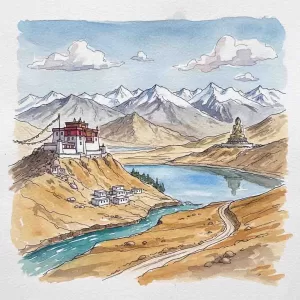

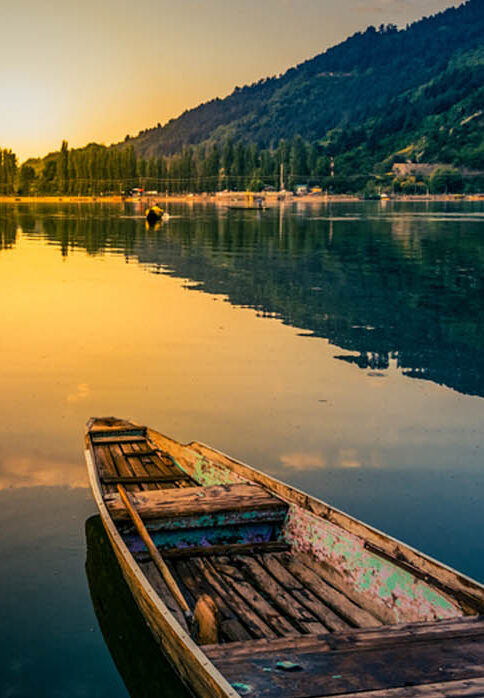
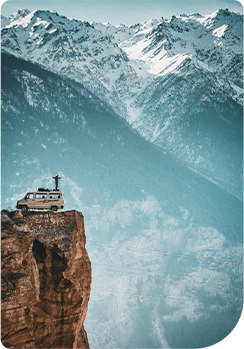
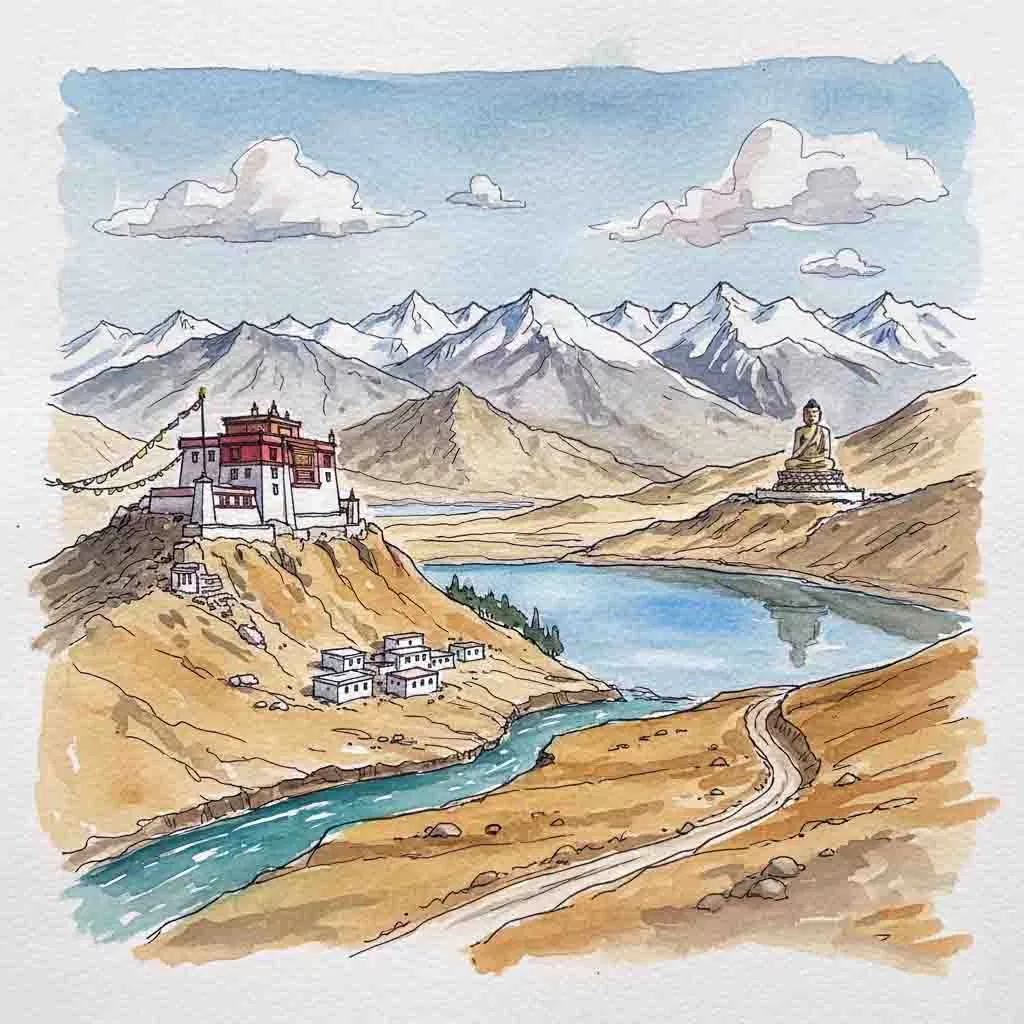
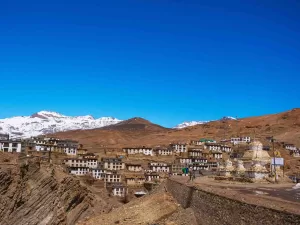
Cradled in the shadow of the Great Himalayan Range, lies Spiti Valley, a remote jagged region in the Lahaul and Spiti district of Himachal Pradesh. Its literal meaning is “The Middle Land”. Spiti Valley forms the natural divide between India and Tibet. It is situated at a staggering height of 10,000 feet (3,000 meters). Several tiny hamlets have mushroomed here, near the mountainsides and life flows in a slow, peaceful rhythm. Nature manifests here in its most extreme forms- rocky cliffs, deep gorges, emerald rivers, and endless rugged mountains dotted with whitewashed monasteries.
The valley is also known for its compelling geography, this cold desert receives little rainfall, leading to its barren yet mesmerizing landscape. The air is crisp, the days are short and the nights light up the sky with billions of stars. Spiti is a land of many contradictions, its post-card perfect landscapes, pristine lakes and ancient Buddhist heritage make it a perfect destination for your next holiday.
The meticulously crafted travel itineraries by Himalaya Visit ensure that you explore the untouched gems of Himachal Pradesh without compromising on your comfort. In this blog, we will explore the Spiti Valley in detail so that you can navigate this mystical land with clarity, preparation, and respect for its fragile ecosystem.
Things to Do in Spiti Valley
Whether it is stark lunar landscapes or high-altitude trek, every experience at the Spiti Valley challenges your endurance and offers you majestic rewards. Here are few unmissable experiences in Spiti Valley.
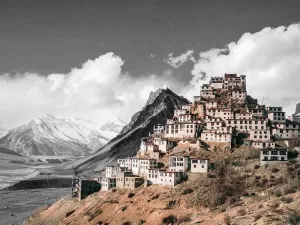
- Visit Key Monastery-The Spiritual Heart of Spiti
The Key monastery is the largest and most iconic monastery in the valley. It is believed to be over a millennium old. It follows the Gelugpa order of Tibetan Buddhism. Here you will find ancient murals, thangkas, and manuscripts. You can interact with resident monks to understand monastic life in detail. The panoramic view from the terrace of the monastery and the prayer flags fluttering against the wind will calm your soul.
Travel Tip: Visit during morning prayers or the annual Chham (mask) dance festival in July for a transformative experience.
- Explore Kibber Village- One of the World’s Highest Villages
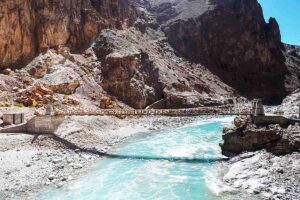
Kibber is one of the highest inhabited villages in the world connected by a motorable road. It is famous as the base for snow leopard expeditions during winter. You can find stone houses, narrow lanes, and mesmerizing views here. Explore nearby attractions such as Chicham Bridge, Asia’s highest suspension bridge at 13,500 feet, and the Kibber Wildlife Sanctuary, home to blue sheep, red foxes, and Himalayan ibex.
Travel Tip: Stay at local homestays to experience high-altitude living.
-
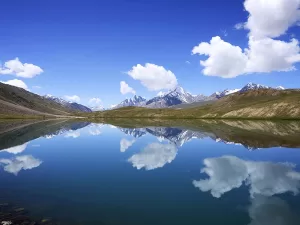
Trek to Chandratal Lake-The Moon Lake of the Himalayas
Chandratal Lake is located at an elevation of 4,300 meters near Kunzum Pass. Known as the “Lake of the Moon,” its crescent-shaped waters reflect every shade of blue through the day. Camping near Chandratal under a sky filled with stars is one of the most surreal experiences in the Himalayas.
Travel Tip: The lake remains accessible only from June to early October. Carry warm clothes even in summer as temperatures during nights drop below freezing.
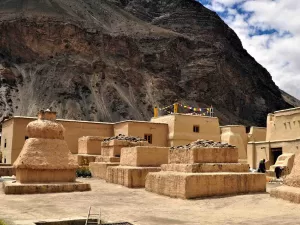
- Discover Tabo Monastery-The Ajanta of the Himalayas
Tabo Monastery is one of the oldest Buddhist monasteries in India. It was founded in 996 CE by the Buddhist scholar Rinchen Zangpo, also known as the “Great Translator.” The mud-walled temples of the monastery, its murals, and scriptures have earned it the nickname “Ajanta of the Himalayas.” The place is also revered for its spiritual importance as the Dalai Lama has expressed a wish to retire here. Spend time exploring its nine temples and caves.
Travel Tip: Photography inside the ancient temples is restricted. Visit the new monastery complex nearby for unrestricted views.
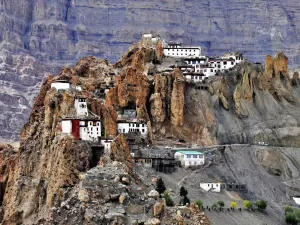
- Visit Dhankar Monastery and Lake-A Balancing Act on the Cliffs
Dhankar Monastery is located on a cliff between the Spiti and Pin Rivers. This was once the seat of the Spitian kings. The structure is marvellous and jaw-dropping and seems to cling to rock formations above a 1,000-foot drop. A short trek from the monastery leads to Dhankar Lake, a hidden turquoise gem surrounded by barren hills.
Travel Tip: Combine Dhankar with a visit to Pin Valley National Park, located just across the river.
- Explore Langza, Hikkim & Komic – The Fossil and Heritage Circuit
There are three villages that form the high-altitude circuit of Spiti.
- Langza- It is known as the Fossil Village, where marine fossils are embedded in rocks.
- Hikkim- This village houses the world’s highest post office, where you can mail a postcard to yourself as a symbolic souvenir.
- Komic– Its name means “eye of a snowcock,”. This is one of the highest villages in Asia (4,587 m) with a serene monastery and unmatched valley views.
Travel Tip: Roads can be rough. A 4×4 vehicle is best, or hire a local cab from Kaza.
- Experience the Pin Valley National Park – Land of the Snow Leopard
Pin Valley is a lush land of greenery located by the Pin River. It is located withing the Cold Desert Biosphere Reserve. The Pin Valley National Park is also home to snow leopards, Siberian ibex, and Himalayan foxes. The valley is also rich in medicinal plants and wildflowers during summer.
Travel Tip: Visit between June and September for clear trails and active wildlife sightings.
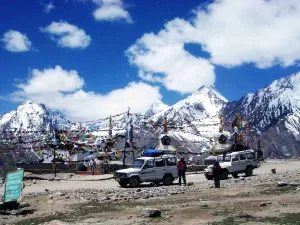
- Ride the Roads to Kunzum Pass-Gateway Between Lahaul and Spiti
Kunzum La connects the Lahaul and Spiti valleys. The pass is home to a small temple dedicated to Goddess Kunzum Devi, where travellers stop to offer prayers before descending.
You can witness some of the most jaw-dropping views here- glaciers, peaks, and the upper reaches of the Chandra River. It’s also the main route leading to Chandratal Lake.
Travel Tip: The pass remains open only from June to October. Start early in the day to avoid afternoon snow or wind.
- Visit Gue Mummy Monastery -The Mysterious Monk
Located near the Indo-Tibet border, Gue Village is home to an extraordinary sight: the naturally preserved body of a Buddhist monk, believed to be over 500 years old. The mummy is seated in a meditative posture, is somehow intact artificial preservation. Gue is home to rugged terrain and remote hamlets, making it one of Spiti’s most offbeat and intriguing destinations.
Travel Tip: Visit nearby attractions such as Tabo and Kaza. The road is narrow but offers panoramic valley views.
- Stargaze in Kaza -Camp Under a Billion Stars
The dry air and minimal pollution at Spiti make it a paradise for stargazers and astrophotographers. The night sky here is so clear that the Milky Way can be seen with the naked eye. Kaza, the main town, offers comfortable guesthouses, cafes, for exploring the region by day and enjoying the canopy of the starts at night. Some homestays even provide telescopes for night observation.
Travel Tip: Visit during new moon nights (June to September) for the clearest skies. Carry warm gear; temperatures drop sharply after dark.
Best Time to Visit Spiti Valley
Every season transforms Spiti Valley into a distinct and dreamy world. The right time to visit depends on what you want to experience.
- Summer (May to October)
This is the ideal time to explore Spiti. Roads from both Manali via Kunzum Pass and Shimla via Kinnaur remain open, making all major villages and monasteries accessible. This is the time when the high-altitude meadows come alive with rare Himalayan flora. The temperature ranges from 15°C to 25°C during the days to 5°C to 10°C during the nights. This season is perfect for trekking, camping, biking, and photography. You can also experience cultural festivals like Ladarcha Fair in Kaza (August) which showcases Spiti’s traditions and crafts.
Travel Tip: Roads might still be rough in the post-snowfall season so late June to early October is the most stable window.
- Winter (November to March):
During the winter season, one can glimpse the raw and surreal form of the Spiti valley. During this season, travellers can witness frozen rivers, whitewashed landscapes, and snow leopards in the Pin Valley region. However, travelling here in winters requires preparation for isolation and sub-zero temperatures. Heavy snowfall often cuts off the Manali route and even sections of the Kinnaur route, making access challenging. The temperature ranges from -5°C to -30°C. This season is ideal for Ideal for snow leopard tracking expeditions and witnessing the Losar Festival (February), marking the Tibetan New Year.
Travel Tip: Electricity and internet may be unreliable, kindly prepare accordingly.
- Spring & Autumn (April and October)
These seasons offer balanced experiences with fewer crowds. The weather during this period is cool and clear, offering unmatched visibility and calm. The temperature ranges from 5°C to 20°C. This season is best for photography before summer rush. If you choose to visit during the autumn season then October is the best time as you can witness the golden-brown hues in the valley. This is the perfect season for budget travelers and solitude seekers
Travel Tip: Carry layers, as temperatures can drop sharply after sunset.
How to Reach Spiti
Getting to Spiti is an unpredictable yet dramatic journey that will take you to some of the country’s most thrilling high-altitude terrains. If you plan to travel by road, then there are two primary routes to reach Spiti-one from Shimla (via Kinnaur) and another from Manali (via Kunzum Pass). Each route offers unique experiences, thrilling challenges, and scenic rewards
- Shimla–Kinnaur–Kaza Route (Open All Year Round)
The route covers stops such as Narkanda, Rampur, Reckong, Peo, Nako, Tabo, Kaza. It covers a distance of 420 km.
Travel Time: 2–3 days by road
This route is the most preferred route for most travellers, especially beginners as it helps in gradual acclimatization to the high altitude. Along the way, travelers encounter stunning stops like Nako Lake, Tabo Monastery, and Dhankar Village. The roads are generally well-maintained, though landslides and roadblocks can occur during monsoon (July–August).
- Manali–Kunzum Pass–Kaza Route (Open May to October)
The route has stops such as Manali, Rohtang Pass, Gramphu, Batal, Kunzum Pass, Kaza. It covers a distance of 200 km.
Travel Time: 10–12 hours by road
This is a slightly shorter yet slightly touger route. Travellers have to cross multiple high-altitude passes like Rohtang (3,978 m) and Kunzum (4,551 m). It is open only from late May to mid-October, depending on the weather snow conditions. Travellers can witness glacial streams, rugged cliffs, and dramatic switchbacks. Travelers using this route should spend at least a night in Manali or Solang Valley to acclimatize before the ascent.
- Nearest Airports
-
-
- Kullu-Manali Airport (Bhuntar): 250 km from Kaza (via Manali route).
- Shimla Airport (Jubbarhatti): 430 km from Kaza (via Kinnaur route).
- Chandigarh Airport: Best for regular flight.
-
- Nearest Railway Stations
- Shimla Railway Station: Connected via Kalka-Shimla narrow-gauge line.
- Kalka Railway Station: Broad-gauge line, connected to Delhi, Chandigarh, and other major cities.
From both, you’ll need to continue by road.
Travel Note:
Always check road conditions and weather updates before departure. Kunzum Pass and Rohtang Pass can close suddenly due to snowfall. Carry cash, as ATMs are limited to Kaza and Tabo.
Tips for Travellers
- Acclimatization is Non-Negotiable- Spiti is located above 3,000 meters, and most villages are higher. To avoid Acute Mountain Sickness (AMS), gain altitude gradually. Stay hydrated, avoid alcohol, and rest if you feel dizzy or short of breath.
- Prepare for Limited Connectivity- Mobile networks are patchy. BSNL has the widest coverage, but internet speeds are minimal outside Kaza. Inform family or friends of your itinerary before you go offline. Carry offline maps and store key contacts locally on your phone.
- Cash is Essential-ATMs exist only in Kaza and Tabo, and they often run dry. Withdraw sufficient cash before entering the valley.
- Drive Smart on Mountain Roads- Spiti’s roads are narrow, unpaved, and prone to landslides. Always start early in the morning, when weather is most stable. Avoid night driving as visibility drops fast.
- Respect Local Culture and Monasteries- Spiti’s people follow Tibetan Buddhism, and their customs are deeply spiritual. Dress modestly and remove shoes before entering monasteries. Always ask before photographing monks or locals.
- Stay at Local Homestays –
Choosing family-run stays not only supports the community and gives insight into Spitian life. These stays often include organic food and traditional heating systems.
- Pack for All Conditions-Even in summer, temperatures can drop drastically. Pack layers, a wind-resistant jacket, sunscreen, and lip balm. Carry reusable water bottles, power banks, and a basic medical kit. Always include altitude-related medicines after consulting your doctor.
- Travel Sustainably-Spiti’s fragile ecosystem can’t absorb mass tourism. Avoid single-use plastic and carry your waste back to major towns. Conserve water as it’s scarce even in summer.
- Check Weather and Permits-No special permits are needed for Indian citizens, but foreigners must carry Inner Line Permits for certain sections near the Tibet border. Always check road and pass status with Himachal Tourism or local authorities before traveling.
- Be Patient-Spiti Runs on Mountain Time-In Spiti, plans shift with the weather, and flexibility is part of the adventure.
Plan Your Spiti Expedition with Himalaya Visit
Explore the cold desert of India with your trusted Himalayan travel partner. Whether you’re seeking monastery trails, remote village stays, high-altitude treks, or peaceful drives through mountain passes, Himalaya Visit ensures a journey that’s safe, seamless, and unforgettable. With local expertise, curated itineraries, and a focus on authentic experiences, every moment in Spiti becomes more than travel-it becomes magic.
Book your Spiti adventure today with Himalaya Visit and discover the Himalayan way of life.